

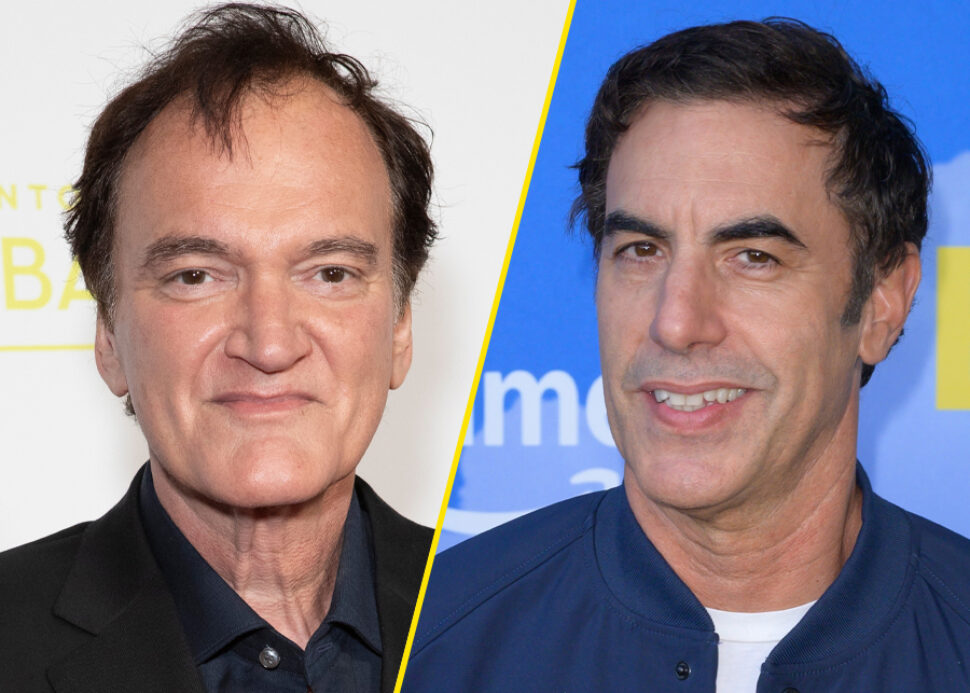
In October 2026, Sony Pictures Entertainment and celebrated British producer Sonia Friedman announced that Tarantino’s theatrical debut, The Popinjay Cavalier, will premiere at the Phoenix Theatre in spring 2027, with Sacha Baron Cohen in the lead role. While fans were still waiting for the elusive “last film,” Tarantino set his sights on London’s West End.
An Offer He “Couldn’t Refuse”
Baron Cohen’s response in the press release almost perfectly replicates the coarse yet sincere humor of his screen personas. “Quentin called, I said yes before he even got to say his first ‘motherf**ker,'” he said. “When the best director in the world calls, you don’t ask questions. I am beyond delighted that we will be losing our West End virginity together, I have made him promise not to be gentle.”
This is not just a joke, because it is indeed Baron Cohen’s first professional West End stage role; although he appeared as Signor Adolfo Pirelli in the movie Sweeney Todd, he came rather late to the London stage. The fact that Tarantino himself has chosen and will direct him is a strong sign that this is no mere vanity piece, but a serious creative enterprise.
His own words are even more terse: he is keen to give the West End a great night out. This restraint makes an interesting contrast with Baron Cohen’s exuberance and suggests a division of labor in their artistic relationship.
1830s Europe and the “Art of Deception”
In the studio’s publicity, The Popinjay Cavalier is described as a rambunctious comedy of deception and disguise set in 1830s Europe and inspired by old Hollywood swashbucklers. The producers mention George Bruce, Ernst Vajda, and Jesse Lasky, Jr. as writers from Hollywood’s Golden Age, suggesting that the tone is more Zorro or The Count of Monte Cristo than Tarantino’s stylized violence.
The plot is as follows, according to Chortle: Baron Cohen is playing Rupert Sebastian Thomas Jr., who refers to himself as “the world’s greatest actor” and goes to Paris to perform at the Comédie-Française. But when he makes a series of ill-advised remarks about the French, what was to be a triumphal trip across the Channel turns into a potentially dangerous one.
This plot itself has metatheatrical implications: an actor who sees himself as great, in a foreign country, gets into trouble because of his words, and finds salvation in disguise and acting. Baron Cohen’s principal career has been that of disguise — he has invented characters who enter situations and uncover the true selves of other people. It would be difficult to believe that Tarantino chose him solely for his comic talent; he must have seen in him this trait of performing in order to survive.
In an interview with The Times, Friedman said that the play was very funny and that it was a tribute to theatre and actors. The performance will feature onstage fencing, acrobatics, and live music — elements that align with Tarantino’s genre-mixing films.
Tarantino’s “West End Immersion”
For Tarantino, this move to the stage was not sudden. He had already, in 2024, indicated to Bill Maher that he was leaning more toward writing for theatre, partly because seeing multiple actors interpret the same role could be really neat. Then, last summer, he confirmed on a podcast that the play was all written and absolutely his next project.
But the details Friedman revealed were more interesting. Tarantino had been deeply involved in London theater, watching numerous plays, and what had impressed her most was his focus on the audience experience. He wanted the audience to have the best freaking night out in the theater they’d had all year. That is a fairly accurate summation of Tarantino’s artistic philosophy: whatever the medium, he is always trying to make his work as tactile and emotional as possible.
The production team includes Tom Pye for scenery and costumes, Natasha Chivers for lighting, Ian Dickinson for sound, Philip d’Orleans for fight direction, and Tim Phillips for music. This last-named figure is particularly important; the authenticity and impact of the fencing on stage will directly affect the chances of the swashbuckling comedy succeeding in the theatrical space.
The “Cost Gap” Between West End and Broadway
The fact that Tarantino has chosen to have his theatrical debut in London’s West End rather than on Broadway itself shows how wisely he has weighed the commercial considerations of such a venture. According to a report published in 2026, London’s West End is far more sympathetic to creators in terms of production costs and ticket pricing.
There is no better comparison than the following data. The stage cost of a Broadway show is three to five times that of London; the minimum weekly wage of a Broadway actor is $2,717; that of a London actor is $1,000 to $1,200; in New York a play must contend with 13 unions of performers; in London, 3. Producer Eleanor Lloyd once offered a vivid example: in New York, getting someone to flip a light switch costs four hours of double pay; in London, they just walk over and flip the switch themselves.
One of Lloyd’s shows cost about $600,000 to produce in the West End, while she estimated it would cost $5 million to $6 million on Broadway. That is why, in the West End, artists have more room to take risks. The opening night is not the day to gamble everything on.
Priced from £25, with more than 16,000 tickets for less than £50, the new play is another demonstration of the accessibility trend. This price point is in the middle-to-low band of London theatre tickets and, in fact, is close to the median actual price paid for a West End show in 2025, which was around £56. This is no doubt a strategic choice on the part of the director and star, for the fact that they are not an event for elites only, but a work intended for the widest possible audience, is clearly indicated.
Baron Cohen’s “Dual Identity”
As the announcement of The Popinjay Cavalier went out, Baron Cohen was also promoting his Ali G: Who Iz I? film, which was scheduled for a limited one-week theatrical release on October 23, 2026. As a publicity stunt, he even led a procession of about 300 Ali G impersonators through the streets of London, becoming an instant sensation on social media.
This temporal overlap provides an intriguing glimpse of the state of Baron Cohen’s career: on one side, the return of a persona on which his entire career was built; on the other, a first venture into serious theatre. In common, they both explore the nature of performance: Ali G is a comedic character disguised as a rapper, while Rupert in The Popinjay Cavalier is the self-proclaimed greatest actor and a master of disguise. Throughout, Baron Cohen seems to be circling the same proposition: what happens when a person is given another layer of identity?
His casting instincts have always been sharp — from John Travolta to Christoph Waltz, he excels at unearthing overlooked depths in his actors. Baron Cohen’s public image is too strong — Borat, Ali G, Brüno — so much so that people easily forget he is actually a Cambridge history graduate with a foundation in serious performance. What Tarantino offers him, then, is a chance to strip off all those character costumes and go on stage as an actor, of course in a way that is not gentle.
The Awaited Tenth Film
Inevitably, this play also brings up questions about the tenth and final film. Since Once Upon a Time in Hollywood in 2019, he hasn’t directed a narrative feature, having instead abandoned The Movie Critic and worked with David Fincher on a spin-off of Once Upon a Time in Hollywood, The Further Adventures of Cliff Booth, with Brad Pitt in the lead role and Tarantino writing the screenplay. He is also writing novels and has on several occasions claimed to be in no hurry to direct the so-called final film, partly because he would prefer to wait until his children are a little older before beginning production.
The premiere of The Popinjay Cavalier is scheduled for spring 2027, so for the next year and a half, Tarantino will have to deal with rehearsals and stage performances. This new world, this new unknown that Friedman mentions, might be precisely the kind of unknown Tarantino has been searching for in the later stages of his film career. To a film director who is used to controlling every frame on the set, the theatre’s unrepeatability — with each performance unique, audience reactions immediate, and actor performances fluid — could be exactly what he needs to refresh his mind.
The Popinjay Cavalier begins previews at London’s Phoenix Theatre on February 23, 2027, officially opens on March 18, and runs through June 13. Further casting will be announced later. For fans of the movie and lovers of the theatre alike, this will surely be a fascinating cross-disciplinary experiment: can a genre auteur create that uniquely Tarantino-esque world on stage as well? And what will be the role of Sacha Baron Cohen, the world’s most skilled performer at revealing truth through disguise, in Tarantino’s text?
by JOHN FARHAM
Major News Outlets
- The New York Times: Sacha Baron Cohen to Star in Quentin Tarantino’s Debut Stage Play
- The Guardian: Sacha Baron Cohen to star in Quentin Tarantino’s West End play
- BBC News: Sacha Baron Cohen to star in Quentin Tarantino’s West End play
- The Hollywood Reporter: Quentin Tarantino’s West End Debut Sets Launch Date