

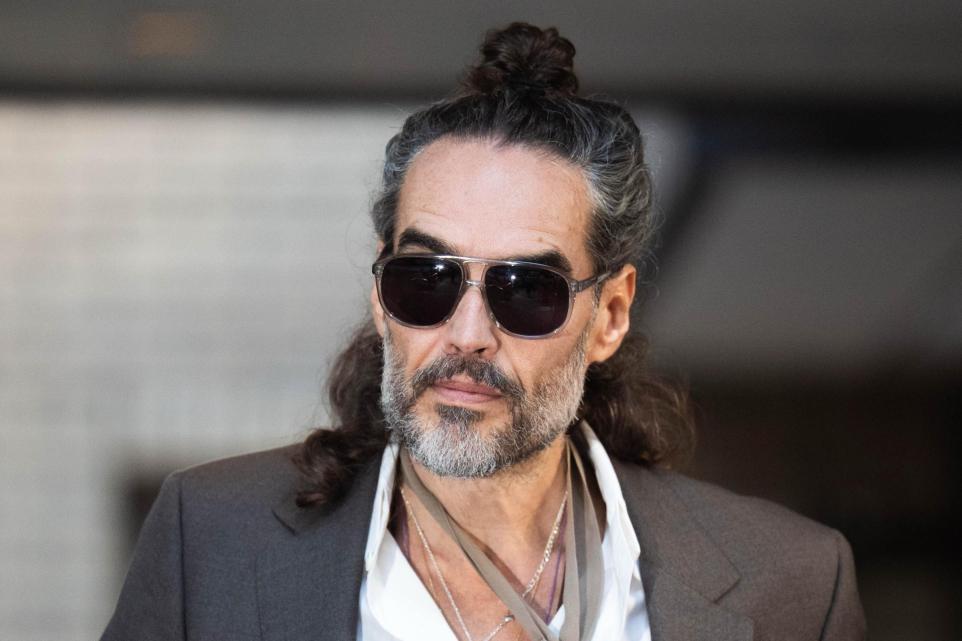
This is not hindsight, but a long-running collective oblivion, a near-twenty-year slumber. Every joke we laughed at now sounds like a victim screaming. When Judge Joel Bennathan said in November 2026 that Brand had always been a sexual predator, he was judging us, the audience, which mistook predation for character, harassment for mischief, and silence for consent.
The “Disaster” We Applauded
It was 2008, and on BBC Radio 2, the comedians Russell Brand and Jonathan Ross shouted into Andrew Sachs’s voicemail that Brand had slept with his granddaughter. More than fifty thousand complaints swamped the BBC, and Brand resigned. Ross was suspended for twelve weeks. In the end, Ofcom fined the BBC £150,000. What did we say? “Over the line, but funny.” “That’s just who he is.” Brand made a comedy routine out of the incident, singing that he was the news that night, which brought the house down.
The paradox is that the scandal which cost Russell Brand his BBC job actually supercharged his career. That same year, The Sun named him “Shagger of the Year” for the third time; he married Katy Perry, starred in Forgetting Sarah Marshall and Get Him to the Greek, and was condemned morally while being rewarded commercially. Richard Osman later said that he thought Brand was awful from the start, first calling him brilliant before correcting himself and saying he thought he was talentless. Osman also pointed out that Brand moved between production companies, projects, and countries like a predator crossing state lines, so that no single employer had to take responsibility and could think it was not their problem.
The Confessions We Published
In 2007, his memoir, My Booky Wook, became a bestseller. It tells how he manipulated a woman into sex through lies, tears, and blackmail, and how he smashed a sex worker’s phone against a wall. Then he asks what kind of man would treat women that way, adding that if that is what he tells us, we should imagine what he leaves out.
Nobody stopped to consider that question. We praised the passage as “honesty” and treated an author’s account of his own abusive tendencies as literary self-deprecation. In 2013, at a live podcast at the Leicester Square Theatre, Brand told a packed room that he had raped someone, and the audience laughed. He crossed his legs and waited for the laughter to die down. That was thirteen years before he was sentenced for rape and sexual assault, and ten years before The Times and Channel 4’s Dispatches published allegations from multiple women.
Why didn’t we ask? Because asking would have meant admitting that the man we loved—the one who preached revolution and spirituality—might have built his persona on predation. When the investigation broke in September 2023, Brand dismissed it as a coordinated attack and a mainstream media conspiracy. He moved to Florida and began selling spirituality and conspiracy theories on YouTube. He gained nearly two million subscribers after the allegations broke, and his merchandise store sold $34.99 “Free Russell” T-shirts claiming he was silenced for speaking the truth.
The most disturbing twist was that he turned his accusers’ allegations into a source of fame. He cast them as pawns in a “deep state” conspiracy to destroy him. Some of his audience followed him down that rabbit hole, convinced that the goofy man from Forgetting Sarah Marshall who sang “Inside of You” could not be the man a court found guilty of anally raping a woman who had asked him to stop.
What Were We Actually Mourning?
Brand’s career has a clear fracture, but hardly anyone saw it. From 2006 to 2008, he was the BBC’s darling, the “Sachsgate” provocateur, the bad boy who made the establishment squirm. Around 2010, he became Hollywood’s oddity, Katy Perry’s husband, the safe rebel the mainstream entertainment industry could absorb and monetize. After 2013, he turned to political activism, telling Jeremy Paxman on Newsnight not to vote, and then discovered that YouTube suited him better than television. After 2017, he became a wellness guru, embraced anti-vaccine narratives during the pandemic, and completed his transformation by becoming a “born-again Christian” in Florida.
Every time he repackaged himself as the misunderstood one, some of us bought it, because Brand’s real talent was never comedy—his timing became bloated and self-indulgent—but making an audience feel they were witnessing something real, unvarnished, and dangerous. We were thrilled by that feeling, until the court documents showed us that for some women the danger was literal.
The judge said Brand showed a casual and arrogant disregard for any woman’s right to say no. His judgment was not destroyed by alcohol or drugs. The defence did not argue that he was too intoxicated to form criminal intent, and the judge explicitly excluded his history of substance abuse as a mitigating factor. None of the victims said he was under the influence during the attacks. The man who spoke on stage about revolution and love, and on his podcast about spirituality and awakening, knew what he was doing to unwilling women in hotel rooms, radio studios, and bars.
Nearly four hundred British entertainment industry figures signed an open letter after his sentencing calling for an end to the culture of “open secrets.” The letter said that calling this a turning point would ignore that justice had taken seventeen years to arrive. Seventeen years passed from Brand laughing on BBC prime time about manipulating women to his sentencing at Southwark Crown Court. During those years, producers kept booking him, hosts kept interviewing him, audiences kept applauding him, and people like me kept writing that he was “complicated, but funny.”
He is not complicated. He is a man who, in 2013, told hundreds of people in a room that he had raped someone, and we laughed. Now he is in prison, and our laughter has finally died, but we are seventeen years too late for the women who waited for a judge to say what should have been said the first time we heard the “joke.”
The Russell Brand we loved existed. But inside him there was another man we chose not to see clearly, an industry we chose not to question, and a laugh we chose not to interrupt.
by CAROLINE FRANKLIN
sources
- AP News (Associated Press): Reports on the sentencing outcome, judge’s remarks (“sexual predator”), and specific charges, suitable for verifying core facts and legal procedures.
https://apnews.com/article/russell-brand-sentenced-convicted-rape-sexual-assault-b1a4d27cbe73ed8b447947fdf9f05d59 - CBC News (Canadian Broadcasting Corporation): Details the joint investigation by The Times and Sunday Times, which exposed new allegations from 6 additional women after sentencing, including accusations of ignoring requests to stop during sexual encounters.
https://www.cbc.ca/news/entertainment/russell-brand-sexual-assault-more-allegations-9.7420884 - The New York Times: Provides systematic summaries of convicted charges, acquitted charges, trial defense arguments, and sentencing details, suitable for gaining a quick understanding of the case’s full scope.
https://www.nytimes.com/article/russell-brand-trial-verdict.html - BBC News: Reports on the Netflix documentary Open Secret and new accusers from The Times, including testimony from ex-girlfriends alleging coercive sexual behavior and control.
https://www.bbc.com/news/articles/cme3dwydp857o