

By the time you finish reading this sentence, someone has probably already explained “abstract expressionism” to you at a dinner party. You’re still none the wiser.
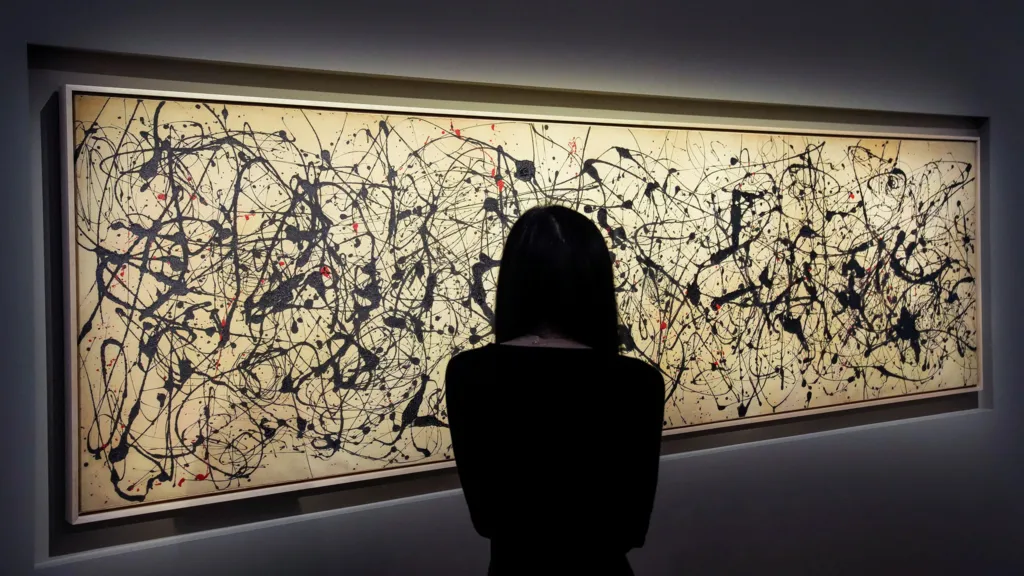
Let me paint you a picture. It’s May 18, 2026. New York. Christie’s auction house. The room is thick with money, nervous energy, and the faint smell of old tweed. On the wall hangs a painting called Number 7A, 1948. It is three and a half metres wide. It’s mostly black drips. There’s a single splash of red, presumably added so no one could say “my toddler could do that” without looking slightly unhinged.
The bidding starts at $82 million. Yes, you read that right. Eighty-two. Million. Dollars. For drips.
And then something extraordinary happens.
Auctioneer Adrien Meyer starts counting in $1 million increments – barely above a whisper, like he’s sharing a secret about your neighbour’s cat. Three specialists on telephones. Two bidders in the room. Over 60 bids. The whole thing lasts seven minutes. Seven minutes for a painting that took Pollock maybe an afternoon to splatter on his barn floor.
The final hammer price? 157million] That’s £135 million if you’re keeping score in proper money.
The previous record for a Pollock at auction was $61.2 million back in 2021. So this isn’t just a record. It’s a three-times-the-previous-record, blow-the-doors-off, make-the-art-world-choke-on-its-champagne kind of moment.
And the buyer? No one knows. A mystery bidder represented by Christie’s global president Alex Rotter. Swiss mega-dealer Iwan Wirth was apparently an underbidder, possibly bidding for Laurene Powell Jobs (yes, that Jobs). But the winner? A ghost. A shadow. Someone with $181 million and a very, very large wall.
Welcome to the glorious absurdity of the art world, where drips are worth more than houses, and the only thing more abstract than the painting is the person buying it.
The Painting Itself (Or: What Exactly Are You Paying For?)
Let’s get specific. Number 7A, 1948 is an oil and enamel painting on raw canvas. It measures 3.34 metres long and 89 centimetres high – roughly the size of a very long kitchen counter, if your kitchen counter was worth more than Beyoncé’s entire back catalogue.
Black paint is swooped, swirled, poured and drizzled across the canvas. There are touches of red. That’s it. That’s the painting.
But here’s the twist that art historians will remind you about while you’re trying to eat your canapés: Christie’s calls it “one of the first truly abstract paintings in the history of art”. “With this work, Pollock finally frees himself from the shackles of conventional easel painting,” the auction house said in a statement.
Apparently, the shackles of conventional easel painting look an awful lot like “not throwing paint at the floor.”
Pollock painted this when he was 36 years old, inside the barn at his Long Island home, near East Hampton. He died in a car crash in 1956 at the tragically young age of 44, which, coincidentally, is also the age at which most people give up trying to understand modern art and just nod politely.
The Previous Owner (Or: Where Did This Thing Come From?)
This painting didn’t just fall out of a skip. It has provenance. That’s a fancy art-world word for “a very impressive receipt trail.”
Number 7A was originally gifted by Pollock to photographer Herber Matter. It then passed to collectors Kimiko and John Powers. Then, in 1977, it was sold to S.I. Newhouse – the American media titan who co-owned Condé Nast, the publishing empire behind Vogue, The New Yorker, and approximately every magazine your dentist’s waiting room has ever offered.
Newhouse died in 2017. His family reportedly spent as much as $700 million on their art collection over the years. They called in art adviser Tobias Meyer – previously the principal auctioneer at Sotheby’s – to help decide the collection’s fate.
The painting hadn’t been seen by the public since 1977 at the Whitney Museum. That’s nearly 50 years hidden away in a private collection. Half a century of no one seeing it, no one arguing about it, no one saying “I could do that” while standing too close to it.
Until now.
The Auction Itself (Or: How to Spend a Billion Dollars in One Evening)
Here’s where it gets properly silly.
The Pollock wasn’t the only thing for sale. It was the centrepiece of the Masterpieces: The Private Collection of S.I. Newhouse sale – 16 lots of modern art that included works by Brâncuși, Rothko, Miró, Warhol, Mondrian, and Picasso.
The Brâncuși sculpture, Danaïde, sold for 107.6million]. A Miró sold for $27.5 million.The total for the night? 631million] But wait – there’s more. Because Christie’s also held a 20th Century Evening Sale immediately afterwards. Combined total for the evening? 1.12 billion. 97% sold by lot.
That’s billion with a B. In one evening. On a Monday. Nearly 20,000 people showed up for the 10-day public exhibition beforehand, just to catch a glimpse of the drips.
The Newhouse collection has now cumulatively sold for more than $1 billion across sales in 2018, 2019, 2023, and this week. Only one other collection in history – Paul Allen’s – has ever crossed the billion-dollar mark at auction.
So when you hear “art market,” don’t think of beret-wearing bohemians sipping absinthe. Think of a financial instrument shaped like a painting. With drips.
Why Is This Painting Worth $181 Million? (The Boring Answer)
Fine. You want the serious bit? Here it is.
Number 7A is the largest Pollock drip painting still in private hands. Most of his major drip works went to museums – the MoMA, the Tate, places that don’t sell things to mysterious billionaires on a Tuesday morning. This one was available. And when something this significant comes to market after nearly 50 years in hiding, the wealthy do what the wealthy do: they fight over it.
Pollock is also a central figure in the abstract expressionist movement. His drip technique is one of the most recognisable and most imitated in art history. He changed the conversation about what painting could be. You don’t have to like it. But you can’t deny that he mattered.
And, of course, there’s the provenance. The S.I. Newhouse name carries weight. Media mogul. Condé Nast royalty. One of the most significant collectors of all time. When you buy a painting from his collection, you’re not just buying art. You’re buying a piece of cultural history.
Or you’re just buying drips. Honestly, who can tell anymore.
The Fourth Most Expensive Painting Ever (And Who’s Ahead)
According to ARTnews, Number 7A is now the fourth most expensive artwork ever sold at auction. Let’s look at the leaderboard, shall we?
1. Salvator Mundi by Leonardo da Vinci – $450.3 million (2017). Attribution debated, restoration controversial, currently somewhere in a Saudi Arabian palace, probably gathering dust.
2. Shot Sage Blue Marilyn by Andy Warhol – $195 million (2022). The one with the oddly confident smile and the even stranger price tag.
3. Le Portrait de l’artiste sans barbe by Vincent van Gogh – Possibly? The exact rankings shift depending on who you ask and whether you adjust for inflation. But the top three are all in the $180–450 million range.
4. Number 7A, 1948 by Jackson Pollock – $181.2 million. Fresh entry. Welcome to the club, drips.
So Pollock is rubbing shoulders with Leonardo, Warhol, and Van Gogh. Not bad for a man who painted on his barn floor.
The “My Toddler Could Do That” Debate (Let’s Settle This)
Oh, you were thinking it. Go on, admit it.
Here’s the thing. Your toddler could not do this. Not because your toddler lacks artistic talent – though let’s be honest, finger painting is not abstract expressionism. But because your toddler lacks the context, the intentionality, and the sheer audacity to break “the shackles of conventional easel painting” at a moment when everyone thought easels were quite nice, actually.
Pollock’s innovation was to abandon the traditional tools and techniques – the wrist, the elbow, the shoulder, the brush, the easel. He put the canvas on the floor. He walked around it. He poured, he dripped, he splattered. He made the act of painting performance. His method was called “action painting” because the action was the point.
Could a toddler do it? Sure. But a toddler wouldn’t mean it. And in art, apparently, meaning is worth about $181 million.
The Verdict (Or: Should You Care?)
Look. I’m not going to pretend that $181 million for drips isn’t completely, utterly, gloriously bonkers. It is. The whole situation is absurd. We’ve created a world where a canvas of splattered paint is worth more than most people’s entire neighbourhoods, and we’ve convinced ourselves that this is normal because of something called “provenance” and a man named S.I. Newhouse.
But here’s the thing: it’s also fascinating.
Number 7A represents a moment – 1948, a barn in Long Island, a man who decided that painting didn’t have to mean what everyone thought it meant. It’s not about the drips. It’s about permission. Permission to try something new. Permission to fail gloriously. Permission to ignore the rules and see what happens.
And if that’s not worth $181 million, I don’t know what is.
(Okay, I do.) It’s not. But let me have my moment.
Now if you’ll excuse me, I need to go throw some paint on a canvas. My barn is currently occupied by a lawnmower and several spiders, but I’m sure they won’t mind.
by ANITA WHIMFORD