

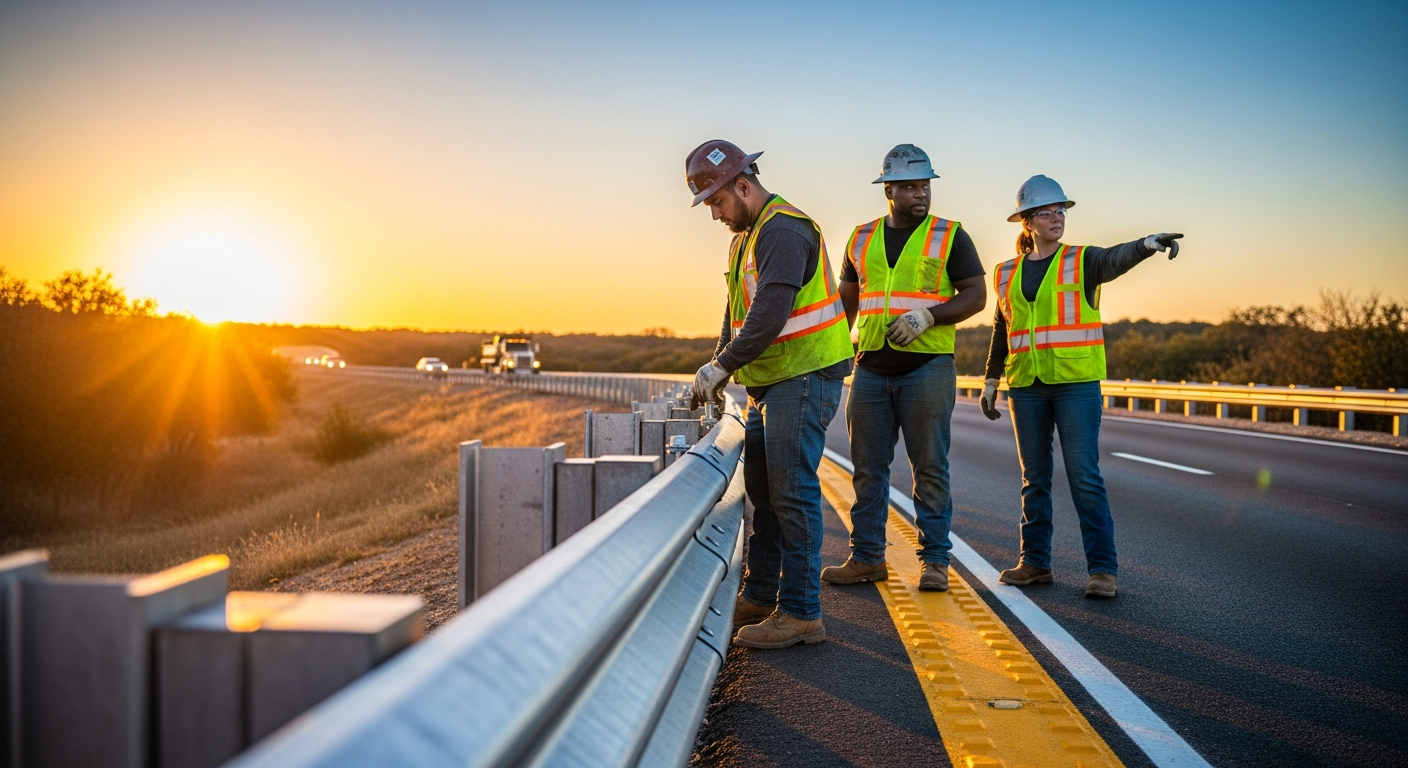
Image generated by Gemini
Some of Texas’ trickiest rural highways are getting targeted safety upgrades, and the winding stretch of State Highway 46 in the Hill Country has become the poster child for the effort. After years of persistent, severe crashes along the corridor, the Texas Department of Transportation (TxDOT) is rolling out a strategic mix of interventions: brighter pavement markings, centerline rumble strips, and new metal beam guard fences, among others.
The pattern isn’t limited to one road, either. It reflects a broader, data-driven push across the state, one focused on low-cost, high-impact treatments that address the specific risks common on two-lane rural roads. If you’ve ever white-knuckled your way through a blind curve on a narrow Hill Country highway at dusk, you already understand why these upgrades can’t come soon enough.
The urgency is rooted in crash data showing persistent dangers on these corridors. On SH 46, for instance, a history of serious collisions prompted TxDOT to accelerate a combination of immediate fixes and larger capital improvements. According to FOX 7 Austin, the agency has already invested approximately $2 million in near-term safety measures along the corridor. These enhancements aren’t random; they directly target the crash patterns most common on rural highways, where head-on impacts and vehicles leaving the roadway are frequent causes of fatalities and serious injuries.
Why TxDOT Is Focusing on Highway 46 and Similar Rural Corridors
State Highway 46, particularly the segment connecting Kendall and Bandera counties between SH 16 and Interstate 10, serves as a critical artery in the Texas Hill Country. But rising traffic volumes and a grim history of severe crashes have heightened concerns among local residents and officials. TxDOT’s focus on this and other similar rural corridors is a direct response to detailed crash analysis. According to the Bandera Bulletin, the crash profile on this stretch of SH 46 is stark: 47% of fatal and serious injury crashes were head-on collisions, while 42% involved vehicles departing the roadway.
That statistical breakdown explains the agency’s choice of countermeasures almost perfectly. The high rate of head-on collisions points to the need for interventions that prevent drivers from drifting across the centerline. The significant number of roadway departure incidents underscores the importance of stronger edge delineation and roadside barriers.
Think of it this way: on most rural two-lane highways, opposing traffic is separated only by a painted line. There’s no median, no buffer zone. A moment of distraction, a glance at a phone, or drowsiness at the wrong time can turn into a catastrophic head-on impact. TxDOT is targeting exactly those scenarios, the kinds of crashes most likely to become fatal when there’s nothing between you and oncoming traffic but paint and hope.
What Safety Features Are Being Installed, and How Do They Work?
The TxDOT highway safety upgrades involve several proven engineering treatments designed to alert drivers, improve guidance, and reduce the severity of crashes when they do occur. These features are being deployed based on the specific risks identified on corridors like SH 46 and in East Texas counties such as Cass and Upshur. Each element serves a distinct purpose within a broader safety system. So what’s actually going in the ground?
High-visibility pavement markings and warning signs
One of the most fundamental upgrades is the installation of brighter, more durable lane delineation. These high-visibility markings are more reflective and easier to see, especially during low-light conditions, rain, or fog. Paired with improved curve and hazard warning signs, these enhancements are designed to give drivers more time to react to changing road conditions and stay within their lane. The goal is straightforward: reduce the risk of both roadway departure and cross-centerline events by making it far easier to see where your lane actually is, even at 10 p.m. in a downpour.
Centerline rumble strips
To directly combat the high number of head-on collisions, TxDOT is installing centerline rumble strips. These are grooves milled into the pavement along the centerline that create a distinct noise and vibration when a vehicle’s tires pass over them. The purpose is to provide an immediate tactile and audible alert to distracted, drowsy, or otherwise inattentive drivers who may be drifting into the opposing lane. Sound familiar? You’ve probably hit one on an interstate shoulder and jolted awake (or at least sat up straighter). Reporting by KPEL 965, citing a study from the University of Louisiana at Lafayette, says centerline rumble strips reduced head-on crashes by 44% on rural two-lane highways. That’s a massive reduction for what amounts to cutting grooves in asphalt.
Metal beam guard fence and bridge rail
For high-risk areas where vehicles might leave the road, TxDOT is installing or upgrading metal beam guard fences and bridge rails. The primary function of a guardrail is to redirect or slow an errant vehicle, preventing it from hitting a more severe roadside hazard like a steep drop-off, culvert, or bridge support. These barriers are crucial safety hardware, and their effectiveness relies on proper design, installation, and maintenance to ensure they perform as intended during an impact. When they work correctly, they’re the difference between a scary but survivable crash and a fatal one.
Here’s a quick breakdown of each feature and what you’ll actually notice on the road:
| Safety Feature | Primary Purpose | Most Relevant Crash Type | What Drivers May Notice |
| High-visibility pavement markings | Improve lane guidance | Lane drift, poor-visibility incidents | Brighter striping, clearer lane edges |
| Warning signs | Increase reaction time | Curve, intersection, and speed-related crashes | More prominent signage ahead of hazards |
| Centerline rumble strips | Alert drivers crossing the centerline | Head-on and opposite-direction sideswipe crashes | Audible buzzing or vibration if tires drift |
| Metal beam guard fence | Reduce severity after roadway departure | Run-off-road crashes | New roadside barrier sections in high-risk areas |
| Bridge rail upgrades | Protect at elevated crossings and structures | Severe departure crashes near bridges | Reinforced barrier areas near bridges |
When Will the Work Happen, and What Should Drivers Expect?
The implementation of these TxDOT highway safety upgrades is happening in phases, with some immediate improvements already underway and larger projects scheduled over the next several years. On SH 46, TxDOT has already initiated seasonal work on markings and signage. According to the Bandera Bulletin, a more substantial short-term project that includes resurfacing and adding a four-foot centerline buffer is expected to be bid in September 2027. This phased approach lets the agency deploy lower-cost fixes quickly while planning for more extensive corridor work down the road.
In other parts of the state, timelines are more immediate. A project in East Texas to add metal beam guard fence and other features in Cass and Upshur counties was scheduled to begin in June and is expected to take approximately 11 months to complete, according to the Gilmer Mirror. If you’re a regular on those corridors, anticipate construction activity and plan a few extra minutes into your drive.
What drivers should expect during construction:
- Temporary lane closures or narrowed lanes, especially during guardrail and resurfacing work
- Reduced speed zones near active work areas
- Periodic flagging or brief traffic holds on rural stretches (yes, the kind where you sit behind a pilot car for a few minutes)
- Shoulder closures around guardrail and bridge-rail installation points
- Changing traffic patterns near intersections receiving upgrades
Construction impacts will vary by location and project phase. You’ll want to monitor district-specific TxDOT alerts and digital message signs for the most current information regarding traffic changes and potential delays on your routes.
Why Guardrail Upgrades Matter Beyond Traffic Engineering
Roadside barriers are a critical component of roadway safety, but their effectiveness depends on more than just being there. The quality of a guardrail system hinges on its design, correct installation, appropriate placement, and ongoing maintenance. An upgrade project like the ones TxDOT is undertaking is significant because it provides an opportunity to replace damaged or outdated hardware with modern systems that meet current safety standards. And that matters, because the condition and design of a barrier can dramatically affect the outcome of a crash.
When roadside barriers are outdated, poorly maintained, or linked to known design concerns, the risk isn’t just theoretical. Documented cases involving defective guardrail systems show how failures in design, installation, or maintenance can turn a protective device into a source of catastrophic injury. Historically, certain guardrail end-terminal systems have faced litigation over performance issues, underscoring that hardware integrity is a genuine public safety concern, not just an engineering footnote. TxDOT’s current upgrades should be understood in that broader context: reducing roadside hazard severity by making sure safety hardware is both present and fully functional.
Can These Upgrades Reduce Texas’ Rising Fatality Problem?
Infrastructure improvements are a critical piece of a wider strategy to address traffic fatalities in Texas, but can they actually move the needle? According to the Federal Highway Administration, roadway departure crashes alone account for more than 50% of all motor vehicle fatalities nationwide. Rural roads are often overrepresented in these statistics due to higher speeds, longer distances to trauma care, and direct exposure to opposing traffic. The countermeasures TxDOT is deploying are considered proactive because they’re designed to mitigate risk without depending solely on perfect driver behavior. And let’s be honest: nobody drives perfectly 100% of the time.
Centerline rumble strips, high-friction surface treatments, and properly installed guardrails are evidence-based interventions for the exact crash patterns that dominate rural fatality data. While these engineering solutions can significantly reduce risk, they work in concert with enforcement, public education campaigns against impaired and distracted driving, and individual driver responsibility. These targeted TxDOT highway safety upgrades represent a meaningful step toward making high-risk corridors more forgiving of human error, but they’re most effective as part of a broader safety culture that includes everything from stricter DUI enforcement to better driver education.
What Texas Drivers Should Watch Next
As TxDOT continues its safety initiatives, Texas drivers will see a mix of near-term and long-term projects materialize on key rural corridors. For those traveling on SH 46, immediate changes like new striping and rumble strips will soon be followed by more substantial intersection and corridor improvements. The broader significance is a statewide focus on proactive crash reduction through enhanced lane guidance, driver alert systems, and more robust roadside protection.
So what should you keep an eye on? The key indicators to monitor will be TxDOT’s funding decisions for future phases, bid schedules for long-term projects like the one slated for 2027 on SH 46, and whether the agency expands this same toolkit of targeted, high-impact safety features to other high-risk rural routes across the state. For now, expect manageable construction disruptions as this critical safety work moves forward, and take the extra few minutes those reduced-speed zones add to your commute as a reasonable trade-off for roads that are genuinely safer on the other side of the work.