

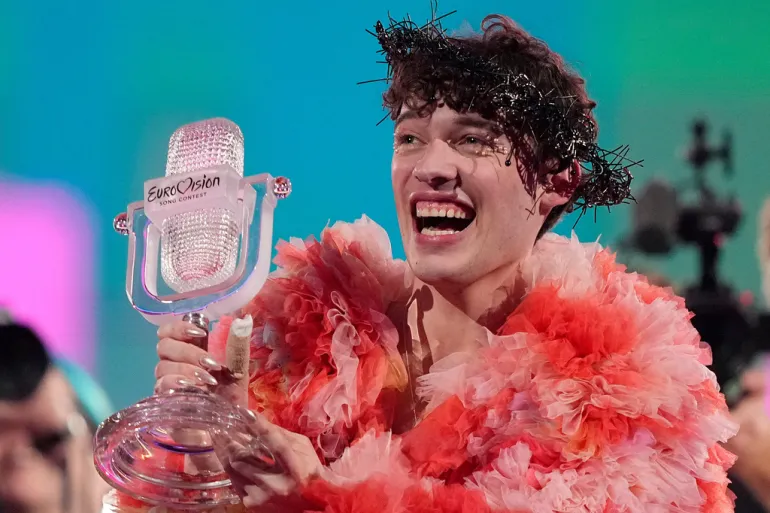
In the glittering, sequin-strewn world of the Eurovision Song Contest, the winner’s glass microphone trophy is the ultimate symbol of triumph. It represents a pinnacle moment in a career, a piece of pop culture history to be displayed with pride. Yet, in a powerful act of conscience that has sent shockwaves through the global entertainment industry, the reigning champion has chosen to send it back.
Nemo, the Swiss singer who captivated the world in 2024 with the operatic pop anthem “The Code,” announced they will return their hard-won trophy. The reason? A profound protest against the European Broadcasting Union’s (EBU) decision to allow Israel to participate in the 2026 contest in Vienna, amid the ongoing war in Gaza .
This is not merely an artist’s statement. It is the latest and most personal blow in a political crisis that has already seen five nations—Spain, the Netherlands, Ireland, Slovenia, and Iceland—formally withdraw from next year’s event . The 70th-anniversary edition of the world’s largest non-sporting live television event, meant to be a celebration of unity, now faces its greatest existential threat, cleaved apart by a conflict thousands of miles from the stage.
The Heart of the Protest: When Ideals Collide with Reality
In a poignant Instagram video, Nemo, the contest’s first non-binary winner, held the trophy before placing it in a box destined for EBU headquarters in Geneva . The accompanying statement cut to the core of the controversy.
“Eurovision says it stands for unity, for inclusion and dignity for all people,” Nemo stated. “Israel’s continued participation… shows a clear conflict between those ideals and the decision made by the EBU” .
The singer framed their protest not as an attack on individual Israeli artists, but on what they see as the instrumentalization of the contest. “This is not about individuals or artists,” Nemo clarified. “It’s about the fact that the contest was repeatedly used to soften the image of a state accused of severe wrongdoing, all while the EBU insists that this contest is non-political” .
The reference is to a September 2025 report by a UN Independent International Commission of Inquiry, which concluded Israel’s actions in Gaza amount to genocide—a claim Israel vehemently denies . For Nemo and the boycotting nations, the EBU’s stance creates an unbearable contradiction, especially when compared to its swift expulsion of Russia following its 2022 invasion of Ukraine .
“When entire countries withdraw, it should be clear that something is deeply wrong,” Nemo said, issuing a stark challenge to the organizers: “Live what you claim. If the values we celebrate on stage aren’t lived off stage, then even the most beautiful songs become meaningless” .
A Crisis in Full Bloom: Boycotts, Backlash, and a Broken Tradition
Nemo’s act of protest is a symptom of a much wider fracture. The decision to return the trophy followed a tense EBU General Assembly in Geneva last week, where new contest rules were approved in a secret ballot—but no vote was held on Israel’s participation, effectively guaranteeing its place . This procedural move triggered the immediate wave of national broadcaster boycotts.
The statements from withdrawing countries were unusually pointed, directly citing the humanitarian catastrophe in Gaza. Ireland’s RTÉ called its participation “unconscionable,” while Slovenia’s broadcaster referenced the deaths of 20,000 children . Iceland’s director-general stated there was “no peace or joy connected to this contest as things stand now” .
The crisis is spreading beyond national broadcasters. In Portugal, 17 artists competing in the national selection contest, Festival da Canção, signed a joint statement refusing to represent the country at Eurovision if they win, rejecting “complicity with the violation of Human Rights” . Furthermore, in a powerful show of solidarity, Charlie McGettigan, Ireland’s 1994 Eurovision winner, announced he too would return his trophy, telling Nemo, “They came across as sincere and a very intelligent person and stated their case very well” .
The EBU, for its part, has expressed sadness but respect for Nemo’s decision. Contest director Martin Green stated, “We respect the deeply held views Nemo has expressed and they will always remain a valued part of the Eurovision Song Contest family” .
An Uncertain Future for the “Non-Political” Party
The 2026 contest in Vienna was meant to be a glittering 70th-anniversary party . Instead, it risks becoming a diminished and deeply polarized event. With major players like Spain (one of the financially crucial “Big Five” nations) absent, and public pressure mounting in other countries like the UK—where a poll found 69% support for a boycott if Israel participates—the EBU’s claim of a “non-political” contest rings hollow to millions .
Nemo’s returned trophy is more than a symbolic gesture; it is a tangible, physical manifestation of a broken trust. It asks the most uncomfortable question of all: Can a song contest dedicated to unity and joy retain its soul when its stage is shared by a nation embroiled in a war that a significant portion of its audience views as a grave injustice?
As the box containing the glass microphone makes its way back to Geneva, Eurovision’s organizers are left with a silence more deafening than any booing crowd. How they respond will define not just a single night of television, but the future identity of a beloved global institution. The music may play on in Vienna, but for many, the harmony has already been lost.
for ShowbizzToday.com Emily Sanders, Vienna