

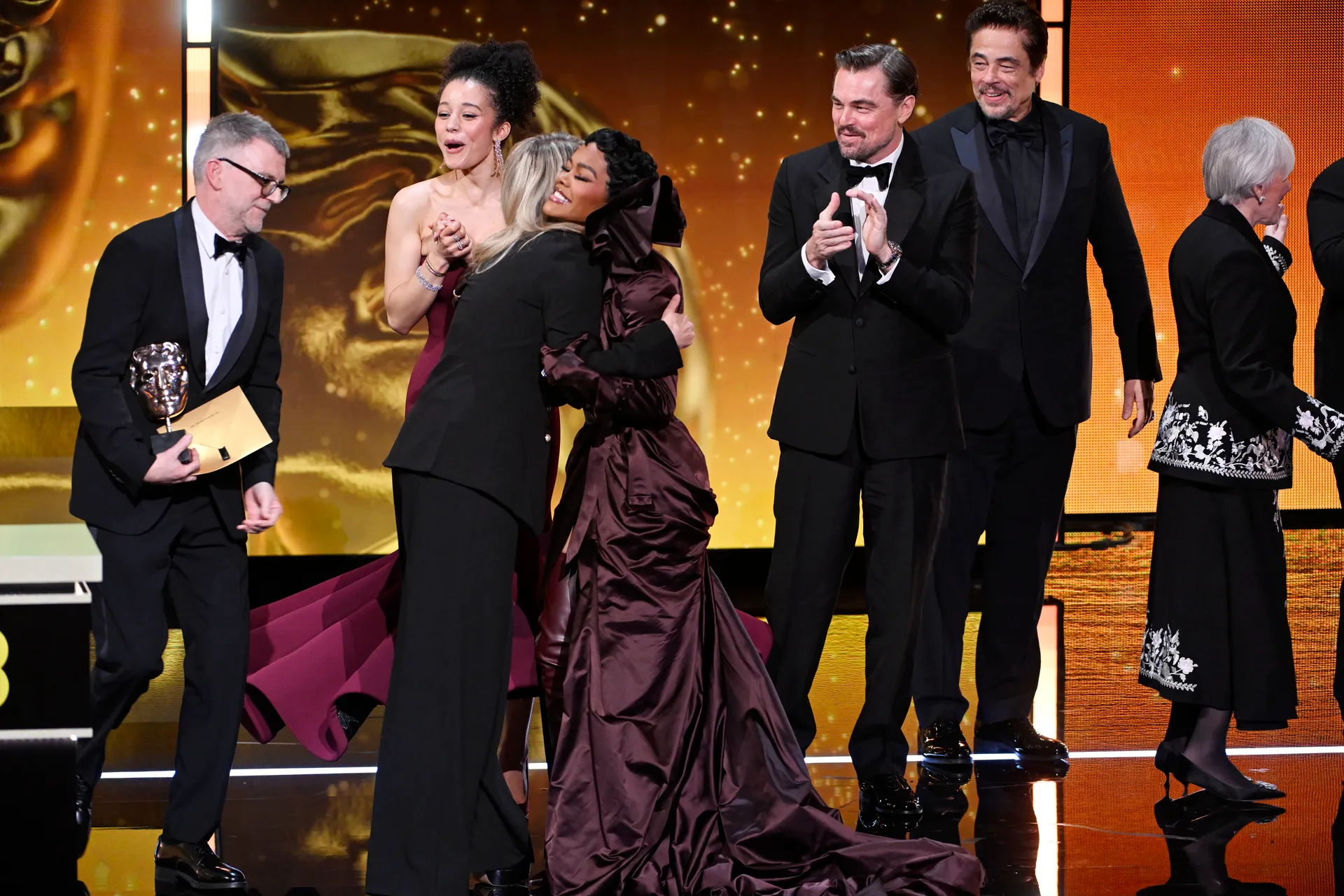
Well, they did it again. Just when we thought awards season had become predictable—when we assumed we could all safely bet the house on Timothée Chalamet and Leonardo DiCaprio—the British Academy of Film and Television Arts looked at the script and said, “Lovely, now let’s set it on fire.”
The 2026 BAFTA Film Awards, held Sunday night at London’s Royal Festival Hall, delivered exactly what awards shows are supposed to deliver: glitter, glamour, genuine emotion, and at least one moment so unexpected that the entire room forgot how to breathe. Hosted with theatrical flair by the endlessly entertaining Alan Cumming , the night belonged to Paul Thomas Anderson’s sweeping epic “One Battle After Another,” which marched away with six trophies including the night’s biggest prize, Best Film . But the story everyone’s still talking about? That would be the man who walked in a nominee and walked out a double winner, leaving DiCaprio and Chalamet clutching their champagne flutes in stunned applause.
Let’s dive into the chaos, the class, and the one upset that has the internet collectively screaming, “Wait, who?!”
The Big Winner: “One Battle” Fought and Conquered
Let’s start with the heavy hitter. Paul Thomas Anderson’s “One Battle After Another”—a political thriller starring Leonardo DiCaprio as a washed-up revolutionary—did exactly what it came to do. It dominated. Six wins from 14 nominations, including the big one: Best Film .
Anderson, who seems to collect awards like some people collect stamps, also took home Best Director and Best Adapted Screenplay . Behind the camera, the film’s technical brilliance was recognized with Best Cinematography and Best Editing, proving that this wasn’t just a pretty face—it was a meticulously crafted machine .
And then there was Sean Penn. The veteran actor, who could probably win an award for reading the phone book, took home Best Supporting Actor for his role in the film, beating out a stacked category that included his own co-star Benicio del Toro, Jacob Elordi (Frankenstein), and Paul Mescal (Hamnet) . It was a reminder that sometimes, experience just… wins.
But here’s the thing about the BAFTAs: they love a British story. And the night’s most British story came wrapped in period costume and literary prestige.
“Hamnet” Finds Its Voice
“Hamnet,” Chloé Zhao’s adaptation of the Maggie O’Farrell novel about Shakespeare’s family, didn’t walk away empty-handed. Far from it. The film took Outstanding British Film, a category so competitive it included 28 Years Later, Bridget Jones: Mad About the Boy, and the delightful-sounding Die My Love starring Jennifer Lawrence and Robert Pattinson .
But the real victory belonged to Jessie Buckley. The Irish actress, who has been quietly delivering extraordinary performances for years, won Best Leading Actress for her portrayal of Agnes Shakespeare . Buckley, who stunned on the red carpet in an electric blue Grecian-style gown with a dramatically scooped back, gave a speech that reminded everyone why we fell in love with her in the first place . She beat a formidable field including Emma Stone, Kate Hudson, and the terrifyingly talented young newcomer Chase Infiniti .
Speaking of newcomers…
The Night’s Biggest Shock: Robert Aramayo’s Double Triumph
Okay, let’s talk about the moment that has everyone still refreshing their Twitter feeds.
Robert Aramayo walked into the Royal Festival Hall as a respected actor with a solid resume. He’d been in The Lord of the Rings: The Rings of Power. He’d done stage work. He was, by any measure, a working actor with a bright future. But nobody—and I mean nobody—expected him to walk out with two BAFTAs .
First came the EE Rising Star Award, voted by the public. That alone was a lovely moment. A win for the little guy. A chance to give a sweet speech and enjoy the evening .
Then came Best Leading Actor.
Let’s just look at the list of people Aramayo beat: Leonardo DiCaprio. Timothée Chalamet. Michael B. Jordan. Ethan Hawke. Jesse Plemons . That’s not a category; that’s a Mount Rushmore of acting talent. And Aramayo, for his performance as a man living with Tourette syndrome in the British dramedy “I Swear,” took the trophy .
The footage is glorious. Aramayo, visibly shaking, made his way to the stage. He gestured toward DiCaprio, seated in the audience, and fought back tears: “I absolutely can’t believe it, I can’t believe that I’m looking at people like you” .
He then shared a story about Ethan Hawke visiting his class at Juilliard years ago, speaking about longevity as an actor. “It had a really great impact on everyone in that room. So to be in this category with you tonight is incredible. Thank you, Ethan” .
It was raw. It was real. It was everything awards shows are supposed to be but rarely are. And it had the room on its feet.
“Sinners” Makes History
Meanwhile, across the room, Ryan Coogler’s “Sinners” was quietly making history. The film, a supernatural horror starring Michael B. Jordan in a dual role, took home three awards, and each one felt significant .
Wunmi Mosaku won Best Supporting Actress for her performance, a win that felt like a career coronation . Ludwig Göransson took Best Original Score, adding another trophy to his ever-growing collection .
But the headline belonged to Coogler himself. He won Best Original Screenplay, becoming the first Black filmmaker ever to win that BAFTA . The audience erupted. It was one of those moments where you realize you’re watching history happen, and the cheers weren’t just polite—they were loud.
The Rest of the Winners: A Quick Spin
For those keeping score at home, here’s a rapid-fire tour of the night’s other winners:
- Best Animated Film: Zootropolis 2 (because of course Disney isn’t done with those talking animals yet)
- Best Documentary: Mr. Nobody Against Putin (a title that tells you everything you need to know)
- Best Film Not in the English Language: Sentimental Value (Norway’s entry, which also picked up multiple nominations)
- Best Children’s & Family Film: Boong (a Manipuri film backed by Farhan Akhtar and Ritesh Sidhwani—yes, really)
- Best Casting: I Swear (adding to Aramayo’s fairy-tale evening)
- Costume Design, Makeup, Production Design: Frankenstein swept the craft categories, because nothing says “BAFTA” like Gothic horror
The Red Carpet: Fashion, Romance, and Royalty
Let’s be honest: half the fun of awards shows is the fashion. And this year’s BAFTA red carpet did not disappoint.
Teyana Taylor arrived in a custom Burberry gown designed by Daniel Lee—a stunning combination of magenta silk duchess satin, structured like a corset-meets-trench-coat, with a collar shaped like a blooming rose . She looked like she’d stepped out of a painting and decided to conquer the world.
Emma Stone braved the February chill in a backless Louis Vuitton black dress with a keyhole cut-out . Carey Mulligan went navy and nearly-backless, paired with a relaxed bob that screamed “I’m effortlessly chic and I know it” .
Jessie Buckley was a vision in electric blue Chanel . Chase Infiniti, the 19-year-old breakout from One Battle After Another, continued her love affair with Louis Vuitton in a burgundy fishtail gown .
And then there were the couples. Paul Mescal and his girlfriend Gracie Abrams made their red carpet debut as a couple, posing for photos and generally looking adorable . He wore a loose black suit with a simple white shirt; she matched effortlessly. It was the kind of low-key, high-impact style that makes you realize some people just have it.
Oh, and the royals showed up too. The Prince and Princess of Wales attended, with Prince William speaking in his role as BAFTA president about supporting the UK’s creative industries . They looked untroubled by whatever palace dramas are currently brewing, which is probably the most royal thing you can do.
The Emotional Moments: John Davidson’s Unforgettable Night
Sometimes, the most powerful moments aren’t on the teleprompter.
John Davidson, the Scottish campaigner whose life story inspired I Swear, attended the ceremony to support the film. When Aramayo won the Rising Star Award, host Alan Cumming had to gently remind the audience that Davidson’s Tourette syndrome meant his vocal tics were involuntary . It was a small but important moment of education on a global stage.
Later in the evening, Davidson reportedly left the event of his own accord—but not before making his presence felt and reminding everyone what the film was really about .
The Fellowship and the Legacy
Two special honors stood out amid the competitive awards.
Donna Langley, the chairwoman of NBCUniversal Entertainment, received the BAFTA Fellowship, the organization’s highest honor . Prince William himself presented it, acknowledging her decades of contribution to the industry.
And Claire Binns, creative director of Picturehouse Cinemas, won the award for Outstanding British Contribution to Cinema . It was a lovely nod to the people who keep cinema alive at the grassroots level—the ones who program the films, run the festivals, and make sure audiences have somewhere to go.
So, What Does It All Mean?
If you’re keeping track of the Oscar race (and let’s be honest, we all are), here’s the takeaway: “One Battle After Another” is the frontrunner. Six BAFTAs, including Best Film and Director, is a formidable haul. It has momentum, it has pedigree, and it has Leonardo DiCaprio doing that thing where he looks intense and broods beautifully.
But BAFTAs don’t always translate to Oscars. The British Academy has its own tastes, its own quirks, its own love for local stories. I Swear won’t repeat its Best Actor shocker at the Dolby Theatre—the competition there is simply too international. But for one glorious night in London, Robert Aramayo was king.
And that’s the magic of awards season. It’s unpredictable. It’s chaotic. It makes us gasp, cheer, and occasionally yell at our television screens.
The 2026 BAFTAs reminded us that cinema is about more than box office numbers and studio politics. It’s about performances that move us, stories that challenge us, and the occasional moment when a relative unknown looks at Leonardo DiCaprio and says, “I can’t believe I’m here.”
Neither could we, Robert. Neither could we.
by Mark Hiller