

Every year, the Rock & Roll Hall of Fame announces its nominees, and every year, the internet collectively loses its mind. Is this band “rock” enough? Is that artist deserving? Should hip-hop even be in a “rock” hall? The arguments rage, the hot takes multiply, and somewhere in Cleveland, a bronze bust quietly waits for its next occupant.
But this year’s list? This year’s list is something special.
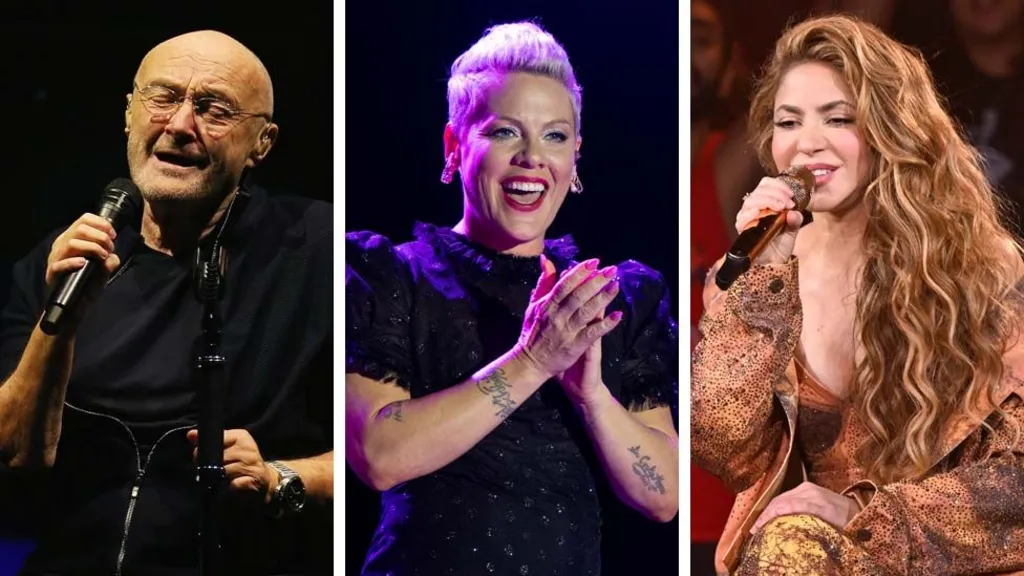
The Rock & Roll Hall of Fame Foundation dropped its 2026 nominee list on Wednesday, and it’s a beautiful, chaotic, genre-defying mess in the best possible way . Seventeen artists spanning pop, metal, R&B, hip-hop, Britpop, and everything in between are now in the running for music’s most prestigious honor . And for the first time, three of the biggest names in pop—Phil Collins, Pink, and Shakira—find themselves on the ballot alongside metal gods, rap pioneers, and at least one band whose lead singer once called the whole thing “some geriatric in a cowboy hat” .
Let’s dive into the glorious madness.
The Complete List: A Study in Beautiful Diversity
Before we get to the human stories, here’s the full roster of 2026 nominees :
| First-Time Nominees | Returning Nominees |
|---|---|
| Jeff Buckley | The Black Crowes |
| Phil Collins | Mariah Carey |
| Melissa Etheridge | Billy Idol |
| Lauryn Hill | Iron Maiden |
| INXS | Joy Division/New Order |
| New Edition | Oasis |
| Pink | Sade |
| Shakira | |
| Luther Vandross | |
| Wu-Tang Clan |
Ten artists are on the ballot for the first time, a remarkable number that speaks to the Hall’s expanding definition of what “rock and roll” actually means . And at the center of it all are three pop titans whose nominations tell very different, very human stories.
Phil Collins: The Comeback King Who Can’t Come Back
Let’s start with the 75-year-old drummer-singer-songwriter who has somehow never been nominated for his solo work, despite already being in the Hall as a member of Genesis . Phil Collins is finally getting his due as a solo artist, and the timing feels both triumphant and heartbreaking.
Because Phil Collins isn’t celebrating. Not really.
In a recent interview on BBC Radio 2’s Eras podcast, Collins painted a stark picture of his current reality. “Everything that could go wrong with me did go wrong,” he told host Zoe Ball . The list is staggering: five knee surgeries, kidney issues resulting from years of drinking, nerve damage to his hands from a 2007 spinal injury, and a bout with COVID while hospitalized that nearly finished the job .
Today, Collins requires 24-hour live-in nursing care. He’s been sober for two years . He hasn’t performed publicly since 2022, when he played seated with Genesis on their farewell tour . And yet, his music has never been more alive.
A new generation discovered Collins through TikTok, through Stranger Things, through the simple, haunting power of “In the Air Tonight” echoing through countless viral videos. His solo catalog—”Against All Odds,” “Sussudio,” “One More Night,” the impossibly joyful “Easy Lover”—has found new life . He told Ball he might go back into the studio to work on “some things that are half-formed or were never finished” .
For a man whose body has essentially given up, the music hasn’t. That’s the kind of story the Hall of Fame exists to honor.
Pink: The First-Year-Eligible Powerhouse
And then there’s Pink.
Alecia Beth Moore—the woman who taught a generation to “Get This Party Started,” who swung from buildings at the Grammys, who made vulnerability feel like a superpower—is nominated the very first year she’s eligible . Her debut album, Can’t Take Me Home, dropped in April 2000. Twenty-six years later, she’s on the ballot .
Here’s what makes Pink’s nomination so satisfying: she’s never been just a pop star. She’s a rock star trapped in a pop star’s body, a woman whose voice can shatter glass and whose presence can level arenas. Four No. 1 songs. Three No. 1 albums. A career built on refusing to be categorized . She’s the artist your mom loves, your rebellious teenager loves, and your cool aunt claims she discovered first.
The Hall has historically been slow to recognize female artists in the performer category. Last year, no women were among the first-time nominees . This year, Pink joins Shakira, Lauryn Hill, and Melissa Etheridge as first-time female nominees—a correction that feels long overdue .
Shakira: Breaking Latin America’s Ceiling
And then there’s Shakira. The Colombian superstar, whose hips don’t lie and whose catalog spans languages, genres, and decades, is nominated for the first time . And her inclusion carries weight beyond the music.
Here’s a staggering statistic: according to the Miami Herald, just three out of more than 1,000 individual inductees into the Rock & Roll Hall of Fame were born in Latin America . Three. Shakira, with her fusion of rock, pop, and Latin rhythms, could become one of the very few .
She’s been lauded for her ability to bridge cultures, to make the world dance to a beat that doesn’t always come from Nashville or New York . From “Estoy Aquí” to “Hips Don’t Lie” to “Waka Waka,” she’s spent three decades proving that rock and roll is a global language. A nomination—and potentially an induction—would be a long-overdue acknowledgment of that truth.
The Rest of the Madness: Oasis, Wu-Tang, and the Gene Simmons Controversy
Of course, the pop stars aren’t the only story.
Oasis is back on the ballot for the third time, fresh off their massively successful reunion tour . But don’t expect Liam Gallagher to show up in Cleveland with a speech prepared. The famously irreverent singer has previously dismissed the Hall as “some geriatric in a cowboy hat” . When asked about this year’s nomination, he offered a characteristically backhanded compliment, suggesting Oasis didn’t deserve it “as much as Mariah [Carey]. She smashed it” .
Mariah Carey, by the way, is nominated for the third time and has previously noted the irony that “my lawyer got into the Rock & Roll Hall of Fame before me”—referencing entertainment attorney Allen Grubman, who was inducted in 2018 .
Then there’s the Wu-Tang Clan. The Staten Island rap collective, whose 1993 debut *Enter the Wu-Tang (36 Chambers)* rewrote hip-hop’s rulebook, is on the ballot for the first time . Their nomination comes hot on the heels of controversy: Gene Simmons of Kiss recently declared that hip-hop doesn’t “belong” in the Hall of Fame . The Wu’s inclusion feels like a direct rebuttal—a reminder that rock and roll has always been about rebellion, and that includes rebelling against the people who think they get to define it.
Iron Maiden is back for a third attempt, their epic metal anthems finally getting their due. INXS is nominated for the first time, a band that ruled the late ’80s with a swagger that still feels fresh . Luther Vandross, the velvet-voiced R&B legend who died in 2005, is finally on the ballot . Jeff Buckley, whose 1994 masterpiece Grace became his legacy after his tragic drowning in 1997, is also a first-time nominee .
The Bigger Picture: What “Rock” Even Means Anymore
Here’s the thing about the Rock & Roll Hall of Fame: the name is both accurate and completely misleading. It’s not a hall of rock music. It’s a hall of rock and roll—which, if you understand the history, includes everything from blues to R&B to hip-hop to pop. Chuck Berry didn’t invent a genre; he invented an attitude.
John Sykes, chairman of the Rock & Roll Hall of Fame Foundation, put it perfectly in the announcement: “This diverse list of talented nominees recognizes the ever-evolving faces and sounds of Rock & Roll and its continued impact on youth culture” .
That’s the key phrase: continued impact. These aren’t nostalgia acts. These are artists whose music still pulses through the culture, still finds new audiences, still matters.
What Happens Next
The more than 1,200 voters—artists, historians, industry professionals—will now cast their ballots . Between six and eight performers will ultimately be inducted . The winners will be announced in April, with the induction ceremony taking place in Cleveland this fall .
For Phil Collins, a win would be a bittersweet coda to a career marked by triumph and tragedy. For Pink, it would be validation from an institution that hasn’t always known what to do with women who rock. For Shakira, it would be a historic moment for an entire continent. For the Wu-Tang Clan, it would be a middle finger to everyone who ever said hip-hop didn’t belong.
And for the rest of us? It’s a reminder that rock and roll was never just about guitars. It was about the sound of people refusing to be put in boxes. This year’s nominee list? That’s the sound in stereo.
by BOB STEVENS