

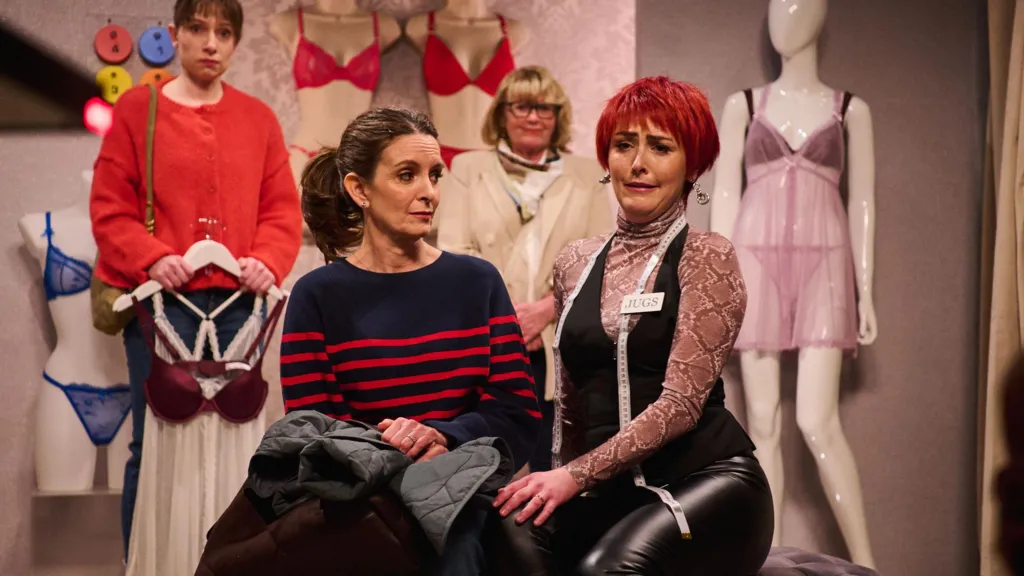
Last Saturday night felt, for about seventy-five minutes, like watching your dad attempt TikTok. You wanted it to work. You were terrified it wouldn’t. And somewhere in the middle, you couldn’t decide whether to laugh or hide behind the sofa.
Saturday Night Live UK finally happened. After fifty years of Americans telling us their version was the greatest thing since sliced bread (and, to be fair, occasionally being right), we had our own go. The cast was announced. The host was chosen. The studio audience filed in. And at 10pm on Sky One, eleven British comedians and one American comedy legend walked onto a stage in London and tried to do the thing that has made America laugh, cringe, and occasionally scream at their televisions for half a century. The verdict? Well. Let’s just say it’s complicated .
The Setup: Why Are We Doing This Again?
First, some context. Saturday Night Live isn’t just a show in America. It’s an institution. It’s launched careers—Bill Murray, Eddie Murphy, Will Ferrell, Tina Fey, the list goes on for pages. It’s survived fifty years, countless cast changes, and the time Donald Trump hosted. So when Sky announced they were bringing it to the UK, the reaction was… let’s call it “characteristically British.” Which is to say: a lot of tutting, some muttered skepticism, and the general assumption that we’d find a way to ruin it .
The format they settled on was simple enough. Same skeleton as the American version: cold open, monologue, sketches, musical guest, Weekend Update, more sketches, sign off. But with a British cast, British writers, and the slightly terrifying instruction to make it “distinctly British.” They recruited eleven cast members—mostly rising stand-ups and character comics rather than household names. Names like Hammed Animashaun, Larry Dean, Emma Sidi, Ania Magliano, and a fellow called Jack Shep who would, it turns out, become very important very quickly .
For the first host, they made a choice that was either genius or deeply ironic: they brought in Tina Fey. The woman who learned her craft on the original SNL. The creator of “30 Rock.” The personification of American sketch comedy. She flew to London, stood in a studio that apparently belongs to Graham Norton (more on him later), and kicked off the whole thing. The audience braced itself. The critics sharpened their pencils. And at 10pm, the screen went live .
The Live Bit: What Actually Happened
The cold open dropped us straight into Number 10. George Fouracres played a bumbling Sir Keir Starmer, being coached by Hammed Animashaun’s David Lammy on how to handle a phone call with Donald Trump. “I’ll do anything,” said Fouracres as Starmer. “Except take a stand” . It was… fine. The jokes landed. The performances were solid. But something felt off. Like watching a perfectly competent cover band play Beatles songs—you recognise the tune, but you’re waiting for the moment it becomes theirs.
Then came Tina Fey’s monologue. And this is where things got interesting. She walked out, did the usual “so great to be here” business, then dropped a line that landed differently on this side of the Atlantic: “I am the youngest person to ever host SNL UK” . It was a joke, obviously. She’s fifty-five. But the audience laughed. And then Nicola Coughlan popped up from the front row. “If this is SNL UK, then why are you our first host?” she asked. “Shouldn’t it be a British icon like David Beckham or Judi Dench or Shrek?”
Fey, deadpan: “How do I put this politely? None of you fuckers would do it.”
The audience gasped. Then laughed. Then Michael Cera stood up—yes, Michael Cera was also in the audience, for reasons nobody has fully explained—and said, “I think you just swore.” Fey shrugged. “Yeah, we’re allowed to swear in this version of the show.” And just like that, the tone was set. SNL UK wasn’t going to be a polite imitation. It was going to be louder, rougher, and significantly more sweary than its American parent. Then Graham Norton appeared—because of course he did—and helped Fey prove her British comedy credentials by reciting lines from Fawlty Towers, Monty Python, and even the “Jet2 Holiday” voice-over that has taken over TikTok .
The Sketches That Worked (And the One About Princess Diana)
Now, let’s talk about what actually made people laugh. Because despite the initial skepticism, there were genuine moments of comedy gold scattered through the seventy-five minutes .
The best bit, by most accounts, was a pre-recorded ad for a skincare product called “Undérage”—a cream “that works so well everyone will think your man is a nonce” . Yes, you read that correctly. A comedy sketch about a moisturiser so effective that women started being accused of dating children. It was dark, it was uncomfortable, and it was unmistakably British. One woman in the ad reported that her husband “lost his record deal and some, but not all, of his fans.” Another lamented that she now had to “carry a laminated card explaining the situation” when she went out . The critics loved it. The audience, reportedly, was torn between horror and hysterics. It was the kind of thing that could only be made here.
Another highlight was a sketch imagining David Attenborough using Jurassic Park technology to resurrect dead British icons for a dinner party. Winston Churchill, Isaac Newton, Agatha Christie, Freddie Mercury, Elizabeth I—they all showed up. But the real star was Jack Shep’s Princess Diana, who spent the entire sketch hovering silently at Attenborough’s shoulder, stealing focus with nothing but facial expressions . The Independent called it a “bang-on Princess Di impression” . The sketch itself may have been hit or miss, but Shep’s Diana was, by all accounts, a thing of beauty.
Then there was the Shakespeare sketch, which saw the Bard (Fouracres again) returning to Stratford from London between plays, each time more affected. What started with a “cunty little earring” and a “slutty little chain” ended with Hamnet accidentally snorting ketamine from his father’s bag . It was weird, it was surreal, and it felt like something that could only exist on this side of the Atlantic.
The “Weekend Update” segment, anchored by Ania Magliano and Paddy Young, was praised for its “close to the bone” jokes, including one about Prince Andrew’s new home, Marsh Fair, being “of course named after the nearby marsh where his body will be found” . It was the kind of joke that would never make it past American censors, but here it landed with the comfortable familiarity of a Have I Got News For You punchline .
The Reviews: A Proper British Mixed Bag
The critics, as you might expect, were divided. This is Britain, after all. We don’t do unanimous praise. We do “could have been a lot worse” .
The Guardian gave it three stars, saying it “could have been a lot, lot worse. And it could have been a lot better.” Lucy Mangan noted that it “felt refreshing to see an ambition/piece of madness like retooling a legacy US brand for this septic isle even being attempted. It did not fail” . That’s basically a rave, in Guardian terms.
The Telegraph was even more impressed, giving it four stars and calling it “shockingly competent” and “occasionally hilarious,” noting that “predictions that a transatlantic SNL would crash and burn proved wide of the mark” . The Financial Times also gave it four stars, praising the “witty and dark” cosmetics ad and suggesting that “this could be a proper home for live comedy, fresh new comics, and punchlines with surprisingly sharp teeth” .
The Independent landed in the middle with three stars, praising the “willingness to push the envelope” and the “notes of new ingredients that could offer something fresh,” while sensibly noting that “judging a show like SNL off its opening episode is foolish” .
And then there was Baz Bamigboye in Deadline, who appeared to have woken up on the wrong side of the bed and stayed there. He described it as “beyond seriously unfunny,” lamenting “stale, pale sketches that seemed to have been exhumed from some old codger’s book of gags” . Which, honestly, is the most British review you could possibly write. We invented complaining about things. It’s practically our national sport.
The Audience Reaction: Five Stars, One Star, and Everything In Between
The people watching at home were, predictably, equally divided. Some turned off within minutes. “SNL UK? It’s rough,” wrote one viewer on X. “The sketches drag, the jokes miss, and the whole thing feels like a parody of a parody” . Another agreed: “Turned it off, it’s not funny, the sketches are weird, that one guy can’t do impressions. Overall, not my thing, not my humour” .
But others found themselves unexpectedly charmed. “Really good,” one user posted. “Some bits haven’t quite landed as much as others, but that’s gonna happen. Looking forward to seeing how it develops” . Another admitted: “I thought it was going to be an absolute train wreck, and have to admit, pleasantly surprised. The Underáge sketch was great” .
Richard Osman and Richard Bacon were among the TV personalities telling followers they loved it . One viewer summed it up neatly: “Expectant of a big pile of preachy unfunny shite, but it had me from the cold open Starmer impression ‘LAMMIE’!”
The overnight viewing figures recorded 226,000 people watching live—a 3.2% audience share, which sounds small until you remember that nobody under forty watches anything live anymore . By Sunday afternoon, a clip of Tina Fey’s monologue had already racked up over 700,000 views on YouTube . The real audience, as with the American version, was never going to be the people watching on the night. It was the people who’d catch the clips the next morning, send them to friends, and slowly build the show into something that actually existed.
The Big Question: Can This Actually Work?
Here’s the thing about British comedy that the Americans don’t quite get: we don’t do optimism. We don’t do “go get ’em.” We don’t do the relentless, pep-rally energy that makes the American SNL feel like a party you weren’t cool enough to be invited to. What we do is cynicism. We do awkwardness. We do characters who are deeply, hilariously wrong about everything. And, as lead producer James Longman put it, we do “darker and more surreal” than our American cousins .
The question is whether that works in a format designed for American energy. The early signs are promising but uncertain. The LA Times review noted that the show “managed to feel very much like its parent show—which is to say, some of it worked well and some of it worked less well, but very little of it didn’t work at all” . Which, honestly, is exactly what people say about the American version. SNL has always been hit-or-miss. That’s the point. You take the bad with the good, and sometimes you get something extraordinary.
The real test will come next week, when Jamie Dornan hosts . The week after that, Riz Ahmed . The initial excitement will have faded. The writers will have to produce new material on a seven-day turnaround, just like the American team. And we’ll find out whether this thing has legs, or whether it was a novelty destined to fade after one season.
But here’s the thing: before episode one had even aired, it was announced that the first season had been extended from six episodes to eight . Someone at Sky clearly saw something they liked. Someone believes this show has a future.
The Swearing Thing
One last thing, because it’s worth mentioning. The American version of SNL, for all its reputation as edgy and boundary-pushing, is actually quite constrained. The FCC regulates broadcast television there. Certain words are simply not allowed. Which is why, when something slips through, it becomes a news story.
Britain doesn’t have that. We have the watershed: 9pm, after which anything goes. And Saturday Night Live UK went all in on that freedom. The cast swore freely. The sketches were darker. The Weekend Update segment delivered a joke about Prince Andrew that would never have made it past American censors . It wasn’t gratuitous. It was just… British.
And that, more than anything, might be what saves this show. Not trying to copy the Americans. Not being polite. Being exactly what we are: rude, cynical, and occasionally brilliant.
The Verdict
So, was it good? Yes and no. Some bits landed. Some bits didn’t. The cast looked nervous in places. The timing was off in others. But there were moments—the Princess Diana sketch, the anti-aging cream ad, the sheer audacity of putting “none of you fuckers would do it” in the opening monologue—that felt like something new. It wasn’t perfect. It wasn’t supposed to be. SNL has never been perfect. It’s been fifty years of glorious, chaotic, occasionally terrible television that somehow, against all odds, kept going .
Maybe this one will too.
The cast has been announced. The stage is set. Eight episodes, with the run extended after positive early buzz . The next host, Jamie Dornan, is a wild card. The one after that, Riz Ahmed, is a safe pair of hands. The writers are working. The cameras are rolling.
And somewhere in London, eleven comedians are getting ready to do it all again next Saturday. God help them. God help us all. I’ll be watching .
BY HUE DENNON