

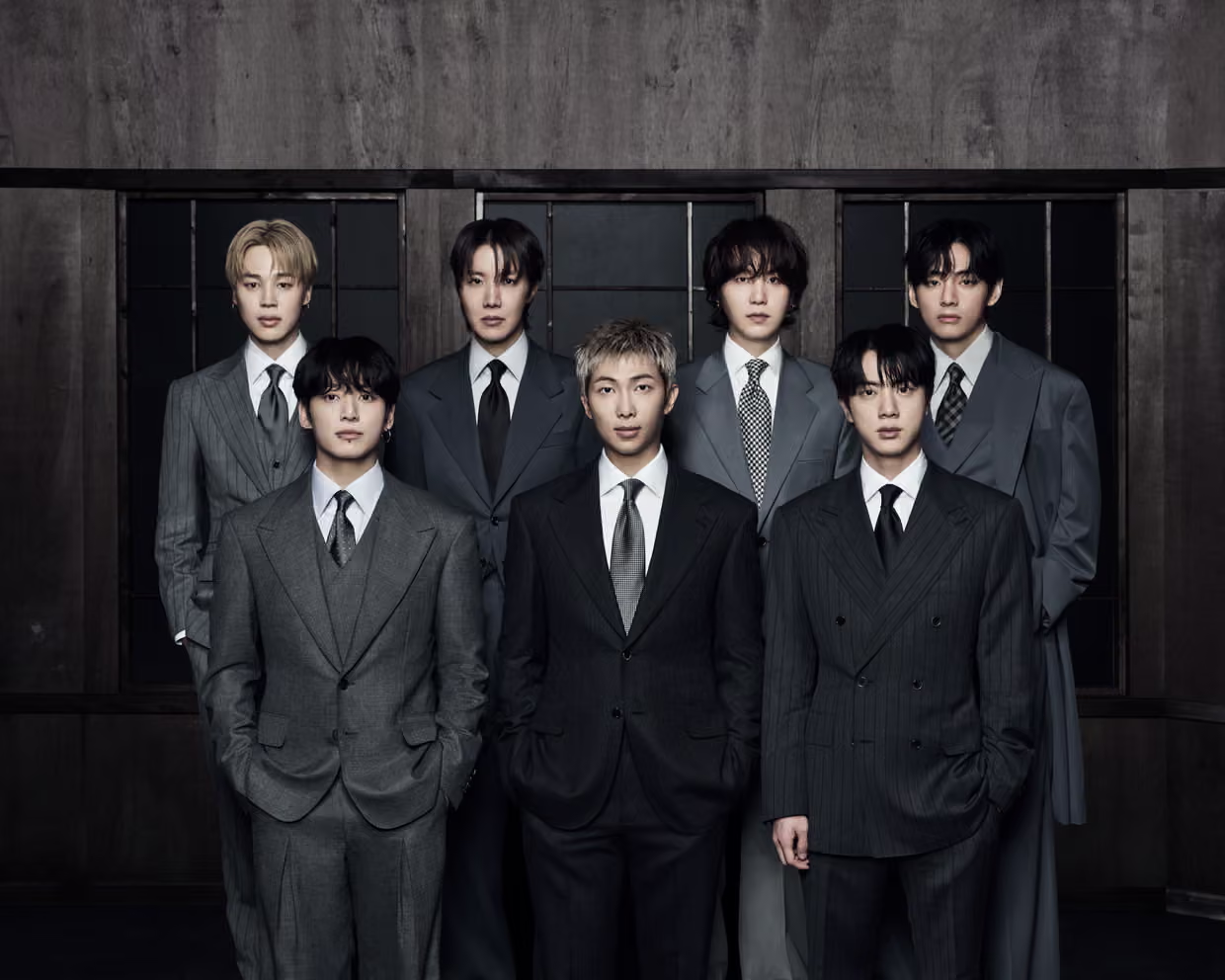
Something happened in Seoul today. Actually, “something” is doing a lot of heavy lifting. “Something” implies a minor event, a blip on the radar. What happened today was an earthquake.
At 8 p.m. local time, the seven members of BTS walked onto a stage in Gwanghwamun Square, and for the first time in nearly four years, they stood together in front of a live audience. And that audience? Two hundred and sixty thousand people, give or take a few thousand ARMY bombs .
Two hundred and sixty thousand. In one square. In one city. On one night.
If you’re wondering what that looks like, picture this: the historic Gyeongbokgung Palace—built in 1395, a symbol of Korean resilience through dynastic collapse, colonial rule, and pro-democracy protests—looming behind a stage where seven young men in matching purple suits are about to remind the world why they became the biggest band on the planet . Seoul police shut down streets. They erected fences, set up metal detectors, deployed 6,700 officers, and brought in an additional 8,200 security personnel from the city government and HYBE. They secured 2,551 toilets. Yes, someone counted the toilets. For 260,000 people, that matters .
And because nothing about BTS is ever small, Netflix streamed the entire hour-long concert to 190 countries. Millions more watched from their living rooms, their phones, their laptops—wherever they could find a screen .
The world stopped for an hour. South Korea’s finance minister went on X to announce that the direct economic effect of just this one concert was in the “trillions of won” . Let that sink in. A single free concert generated more money than most countries see in a year of tourism.
This is the story of that week. Of the album that sold 3.98 million copies in a day. Of the world tour that analysts say could earn $2.2 billion—enough to rival Taylor Swift’s Eras Tour . Of a K-pop industry that has been waiting, holding its breath, for its kings to return.
The Album: “Arirang” and the Rekindling of Fire
Let’s start with the music, because that’s what this is actually about.
BTS’s tenth album, “Arirang,” dropped on Friday. By Saturday, it had sold 3.98 million copies. On its first day . If you’re a musician, please take a moment to process that number. Then feel free to cry.
The title is significant. “Arirang” is Korea’s most beloved folk song, a sentimental anthem about moving from hardship toward something better . The first known recording of Arirang was made in 1896—in the United States, performed by a group of seven Korean men at Howard University . Seven. A century later, seven Korean men are once again at the center of a global conversation about Korean culture. If that symmetry isn’t intentional, it’s at least beautifully cosmic.
The album itself is a statement. For years before their hiatus, BTS had settled into sleek, shimmery retro-disco tracks like “Dynamite” and “Butter”—designed for English-speaking radio, designed to be safe, designed to conquer . They succeeded. They became the biggest K-pop band on Earth. But something got lost along the way.
According to the BBC’s Mark Savage, who reviewed the album, “Arirang” finds the band rekindling the fire of their early work . The opening 15 minutes have the rebellious, rap-heavy energy of 2014’s “Dark & Wild.” “FYA” is a “deliciously dark serving of Jersey club music, full of revving synths and distorted beats.” “Hooligan” builds its rhythm track from the sound of sharpening knives.
“Don’t stand too close to the fire,” they warn.
They’re talking to us. They’re also talking to themselves.
The album doesn’t just assert their dominance—it acknowledges the cost of it. “Swim,” the first single, is subtle and restrained, a song about surrendering to the currents of life and moving forward even when the tide threatens to pull you under . “Merry Go Round” offers a more melancholy reflection: “My life is a broken roller coaster, but maybe I’m the only one to blame / I do my best, but I can’t slow down this merry go round” .
And then there’s “Normal,” which explores the space between spotlight and silence: “Now I understand the truth, some pain is real / If everything’s just happy, that ain’t real” .
Fans will parse these lyrics for months. They’ll wonder if this is about Jungkook’s recent livestream, the one he posted and then deleted, where he shared his frustrations with life as a K-pop idol. They’ll wonder if it’s about the pressure of being seven men carrying an entire industry on their shoulders.
But the album also makes one thing clear: BTS chose to come back. As they sing on “They Don’t Know ‘Bout Us”: “You say we changed? We feel the same” .
The Concert: 260,000 People and a Hurt Ankle
The show itself was supposed to be perfect. Then Friday happened.
RM, the group’s leader, hurt his ankle during rehearsals. His agency announced that his “participation in certain performance elements, such as choreography on stage, will be restricted” . For a band whose live shows are precision-engineered military operations, this was a setback. For the fans who had traveled from Spain, from Malaysia, from Jeonju, it was a moment of collective breath-holding.
But ARMY has been waiting for this moment since 2022. They weren’t going to let a hurt ankle ruin it.
Elsa Llorens Torrubia, 30, from Spain, arrived early. “People are here not just for the show,” she told Reuters. “We’re here for the atmosphere” . Lee Yeon-seo, 36, traveled from the southern city of Jeonju. “My seat is actually toward the front, near the main stage, so I’m even more excited thinking I’ll get to see them up close,” she said .
By noon, the area surrounding Gyeongbokgung Palace was unrecognizable. Police buses lined the streets. Barricades blocked main roads. Nearby museums and metro stations were closed. And everywhere—on hats, on shirts, on light sticks—was purple .
The city government set up medical stations. They secured 2,551 toilets in nearby buildings. They jammed the signals of any unauthorized drones. They even deployed police vehicles to transport wedding guests affected by the traffic disruptions . In Seoul, a BTS concert is a natural disaster, a national holiday, and a logistical nightmare all at once.
And at 8 p.m., the seven men walked on stage. RM, limping slightly, but there. Jin, fresh from military service, grinning. Suga, J-Hope, Jimin, V, Jungkook—all together for the first time since 2022. The square erupted.
The Numbers: Why This Matters Beyond Music
Let me give you some numbers, because the numbers tell a story that words can’t quite capture.
First: the album. “Arirang” was pre-saved 5 million times on Spotify—the highest ever for a K-pop act . It sold 3.98 million copies on its first day . On its first day.
Second: the tour. BTS’s upcoming world tour spans 34 regions and 82 shows, with dates stretching into 2027 . Analysts at iM Securities project total attendance between 5 million and 6 million fans . IBK Investment & Securities forecasts total tour revenue of 2.7 trillion won—that’s about $1.8 billion . Some estimates go higher: 2.9 trillion won, or $2.2 billion, including merchandise and tourism .
To put that in perspective: Taylor Swift’s Eras Tour is estimated to have grossed around $2 billion. BTS could match that. A K-pop group from South Korea could match the biggest Western tour in history.
Third: the economy. South Korea’s finance minister went on X to say the direct economic effect of the Saturday comeback concert alone was in the “trillions of won” . Museums and heritage sites around Gwanghwamun Square rolled out themed merchandise and special exhibits, preparing for an influx of visitors drawn as much by Korea’s history as by its music .
This is not a comeback. This is a coronation.
The Industry: What BTS Means for K-Pop in 2026
Here’s something you need to understand about BTS’s return: the K-pop industry has been waiting for it.
During the band’s four-year hiatus, HYBE’s operating profit dropped by almost 37.5% . Other groups stepped up—Stray Kids, NewJeans, a dozen others—but the hole at the center of the industry was impossible to fill. Album sales stalled. Scandals shook the industry’s foundations . And everyone, quietly, asked the same question: will they come back? Will it be the same?
The answer, based on this week, is yes. And no.
BTS has returned to a K-pop landscape that they helped create. The Oscar-winning success of “Parasite,” the global dominance of “Squid Game,” the recent Oscar wins for “KPop Demon Hunters”—all of it rests on the foundation that BTS built . They didn’t just make Korean music popular; they made Korean culture exportable. They made it desirable. They made it global.
But they’ve also returned to an industry that has changed. The pressure is different. The expectations are different. And as their lyrics make clear, they are different.
In a promotional video for “Arirang,” the seven members sit around a table listening to a wax cylinder recording of the original Arirang folk song—the one recorded in 1896 by seven Korean men at Howard University . They sit in silence, absorbing the weight of history. Then they get up and make their own.
The Future: Where Do They Go From Here?
The tour starts next month. Eighty-two shows across 34 regions. A 360-degree stage that means no bad seats and maximum capacity . Millions of fans. Billions of dollars.
But the real question isn’t how much money they’ll make. The real question is what they’ll do with it. What they’ll do with their platform. What they’ll do with the next chapter of a story that has already changed the world.
Carmen Low, 32, a fan in Malaysia, put it this way: “Their message has always centred around self-reflection, resilience and courage to keep moving forward, even when life feels uncertain. In many ways, those themes feel just as relevant—if not more—in 2026. Their return could be a reminder of those values, encouraging conversations about identity, dreams, mental health, and what it means to grow up in a complex world” .
That’s the thing about BTS. They’re not just a band. They’re a mirror. They reflect what we want to be—braver, more resilient, more connected—and also what we are: confused, exhausted, trying our best.
At the end of the concert, the seven men stood together on stage, 260,000 people screaming in front of them, millions more watching around the world. RM, still limping, raised his hand. The others followed. And for a moment, the chaos of the world—the wars, the politics, the endless noise—faded into the background.
There was only the music. There was only the moment. There were seven men, back where they belong.
by FRANK HARMAN