

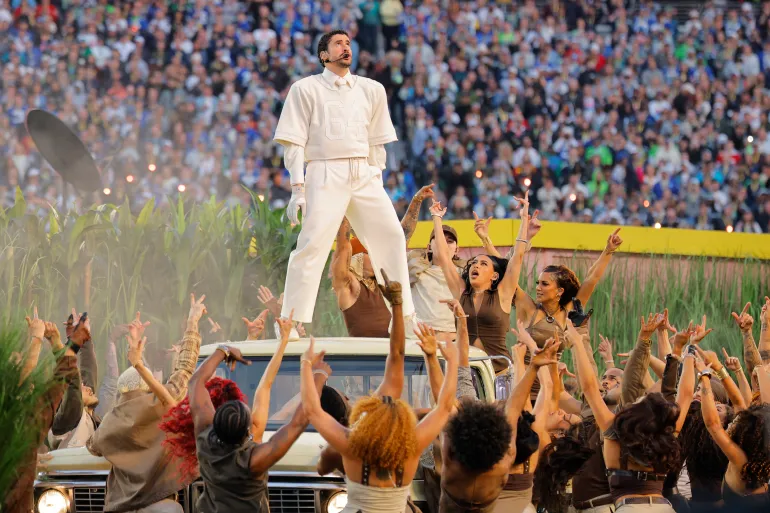
In the heart of Silicon Valley, where technology builds the future, Super Bowl LX offered a different kind of blueprint—one written in Spanglish, fueled by reggaeton, and delivered with the unapologetic pride of a generation. At Levi’s Stadium in Santa Clara, history wasn’t just made on the field with the Seattle Seahawks’ 29-13 victory over the New England Patriots; it was made at halftime, when Bad Bunny stepped onto the world’s biggest stage and didn’t ask for permission. He claimed it.
For 13 minutes, the Puerto Rican superstar, born Benito Antonio Martínez Ocasio, performed a cultural masterclass. He didn’t dilute his sound for a mainstream American audience; he amplified it, performing almost entirely in Spanish. He brought out legends like Ricky Martin and Lady Gaga, not as token guests, but as co-conspirators in a celebration of Latin joy, rhythm, and identity. When he closed his set not with a plea for acceptance, but with a declarative “God bless America—all Americas,” it was more than a lyric. It was a mission statement for a new, pluralistic American culture. The old guard heard a challenge. A new, massive audience heard a homecoming.
The Numbers Don’t Lie: A Demographic Revolution
To understand why this moment was inevitable, you have to look at the data. Bad Bunny wasn’t a risky choice by the NFL; he was a strategic inevitability. For years, the league has been meticulously courting the Latino fanbase, a demographic powerhouse that is reshaping American culture and commerce.
The statistics are staggering:
- The Audience: The NFL estimates that over 40 million Latino fans regularly engage with the league. For Super Bowl LX, early Nielsen data suggests a historic viewership spike in Hispanic households, with numbers soaring over 25% higher than the previous year’s game.
- The Economic Engine: Latino purchasing power in the U.S. is projected to exceed $2.8 trillion. For advertisers paying a record $10 million for a 30-second spot, Bad Bunny’s halftime was a direct pipeline to this thriving market.
- The Cultural Currency: In 2025, Bad Bunny made history as the first artist to perform entirely in Spanish at the Grammy Awards, where he also won the coveted Album of the Year. His album DeBÍ TiRAR MáS FOToS spent over 40 weeks in the top 10. The Super Bowl stage was simply the largest platform for an artist who already ruled the charts.
The NFL’s decision was a cold, calculated, and brilliant business move. “He is one of the greatest artists in the world,” Commissioner Roger Goodell said in the lead-up to the game. The league wasn’t just booking a performer; it was formally recognizing a seismic shift in who the American audience is and what it wants to hear.
More Than Music: A Political Statement in a Football Stadium
Yet, for Bad Bunny, the performance was never just a concert. It was the culmination of a years-long stance. He had previously avoided U.S. tours, citing opposition to U.S. Immigration and Customs Enforcement (ICE) policies. To take the Super Bowl stage, then, was not to abandon his principles but to weaponize the platform.
His set was a vibrant, joyous act of representation, but his closing line—”God bless America, all Americas”—was a pointed political rebuke. It was a call for inclusivity that stretched beyond borders, encompassing North, Central, and South America. The backlash from some corners was immediate and fierce. Former President Donald Trump called the performance “a slap in the face for our country,” framing it as an affront to a monolingual, monocultural ideal of America.
But this criticism only served to highlight the generational and cultural rift Bad Bunny embodies. For millions of younger viewers, including second- and third-generation Latinos, his performance wasn’t divisive; it was validating. It was the first time they saw their language, their rhythms, and their cultural pride centered without apology in the most American of events. He wasn’t assimilating; America was expanding to include him.
The Ripple Effect: From Halftime to Everyday Life
The impact of Bad Bunny’s Super Bowl extends far beyond one night. It has ignited conversations in living rooms and boardrooms alike.
In Culture: The performance has supercharged the “Latin Boom” in music from a trend into a permanent, dominant force. Streaming numbers for Bad Bunny’s catalog, as well as for artists like Karol G and Peso Pluma, saw instant, dramatic increases. Music executives now speak of “The Bad Bunny Effect”—the proven commercial power of authentic, Spanish-first artistry on the biggest possible stages.
In Marketing: The advertisers who shared his stage took note. While commercials featured the usual parade of A-listers like Chris Hemsworth and Matthew McConaughey, the most resonant spot may have been a simple, poignant ad from Rocket and Redfin featuring Lady Gaga singing “Won’t You Be My Neighbor?”—a quiet anthem of community that echoed Bad Bunny’s thematic call for unity.
In the Game Itself: Even the sports narrative of the night felt secondary. While Seahawks running back Kenneth Walker III earned MVP honors and quarterback Sam Darnold completed a storybook redemption, post-game coverage was dominated by analysis of the halftime show. It was a clear signal: the spectacle can now overshadow the sport.
The New American Mainstream
Super Bowl LX will be remembered not for a final score of 29-13, but for the moment America’s most-watched television broadcast finally sounded like America itself. Bad Bunny’s performance was a declaration that Latin culture is not a niche—it is the mainstream. It is the sound of a demographic future that has already arrived, demanding not just recognition but celebration.
He demonstrated that the power to “capture the nation” no longer requires conforming to an old archetype. It requires speaking your truth, in your language, with your rhythm, and trusting that the nation—a newer, bigger, more diverse nation—is ready to listen and move with you. The numbers, the noise, and the newfound sense of belonging all prove one thing: Benito didn’t just play the Super Bowl. He changed the game.
by Erica Thorton